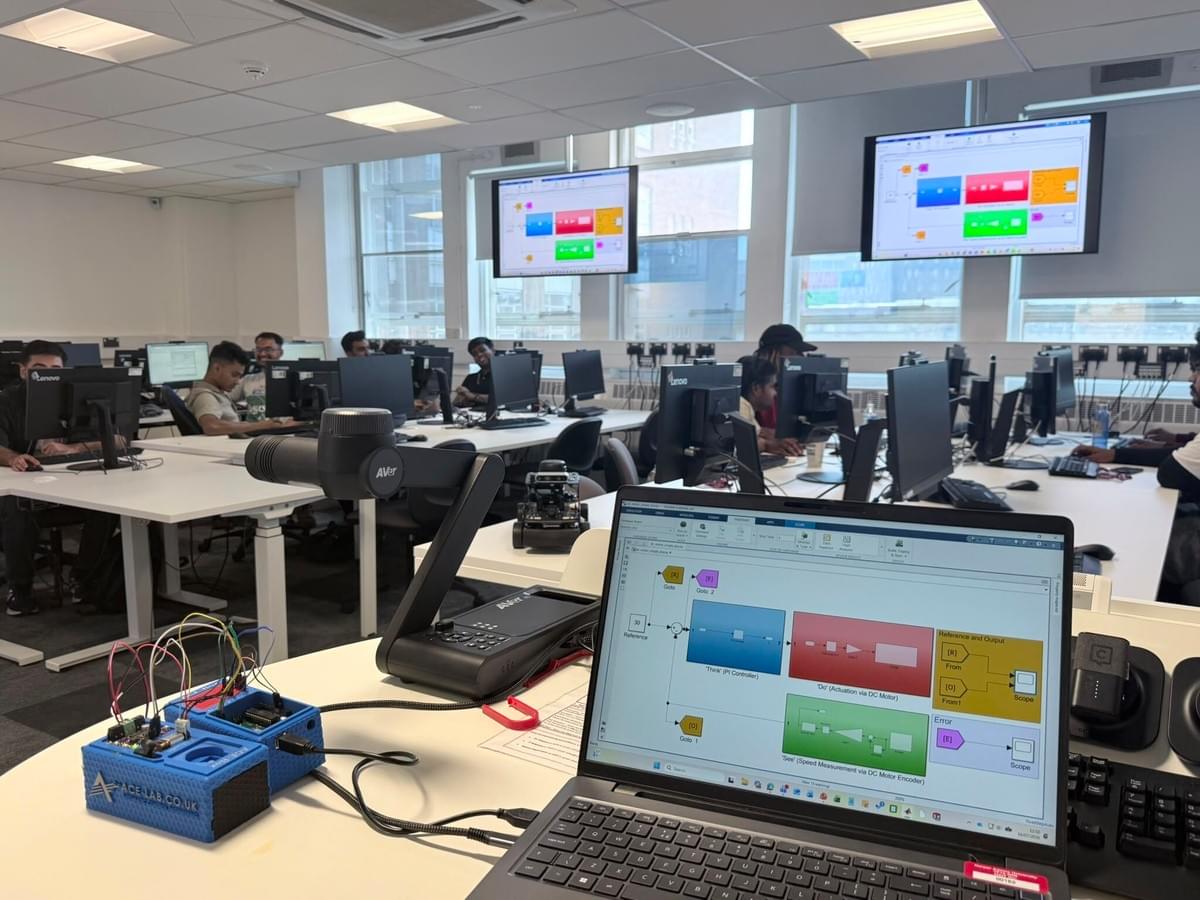

ACE-Lab was used as part of an invited guest lecture at Aston University on the Future Vehicle Technologies MSc, exploring practical approaches to autonomous vehicle control.
The session focused on motor speed control and path tracking, with students using MATLAB, Simulink and the ACE-Lab hardware to work through a practical DC motor speed-control exercise.
Students began with a PI controller whose initial gains did not satisfy the required system performance. They then progressively improved the controller using three approaches: tuning from prior knowledge and observation, applying their understanding of how controller gains influence system response, and finally adopting a model-based design approach.
For the model-based stage, students identified a mathematical model of the motor using linear least squares, tuned the controller in simulation and then validated the resulting controller on the physical hardware.
The exercise provided a practical route through several important control engineering activities, including requirements capture, modelling, simulation, controller tuning, delays and implementation effects, testing and validation.
Within the 90-minute session, students progressively improved the controller until the required performance was achieved.
The activity demonstrated how relatively simple hardware can be used to connect fundamental control theory with the wider engineering process required when controllers are implemented on real systems.