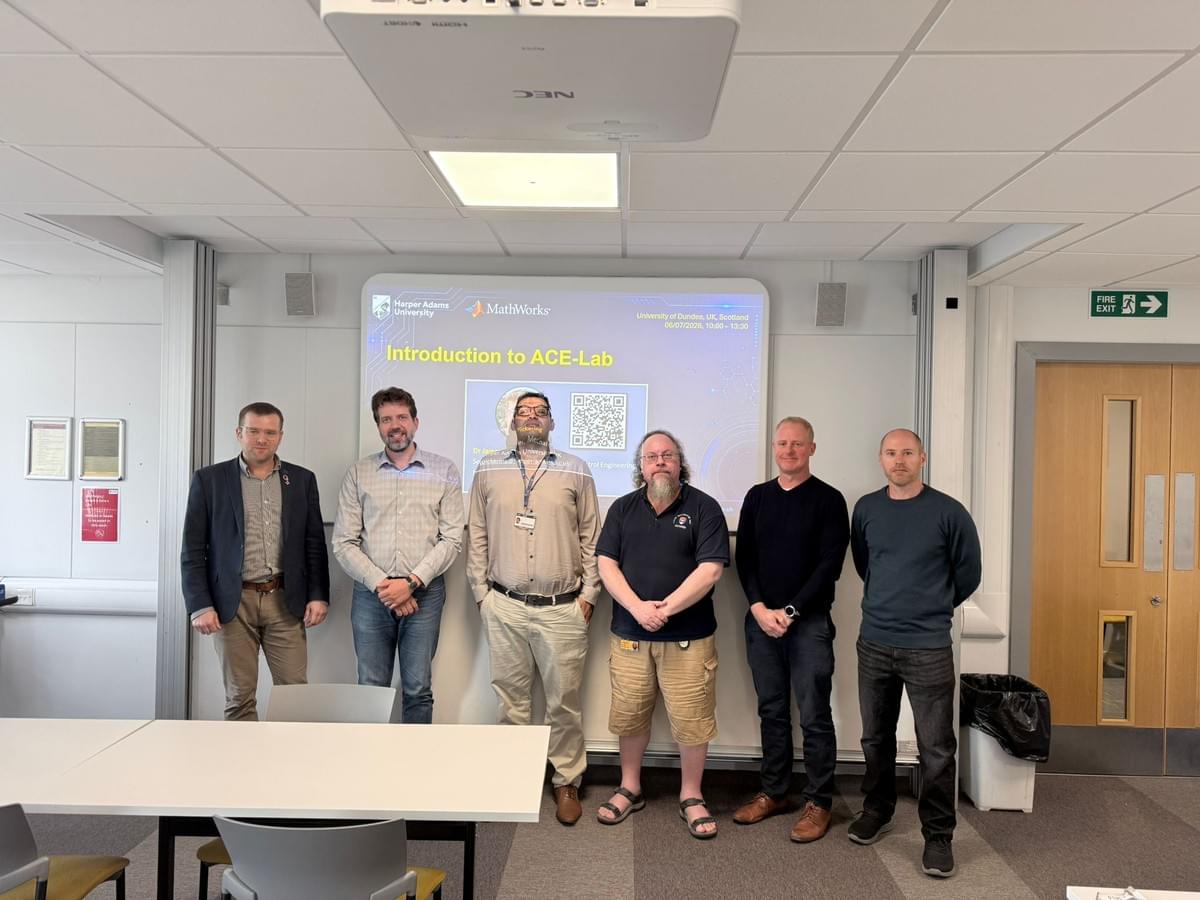

An ACE-Lab workshop was delivered at the University of Dundee exploring how practical control engineering can be introduced earlier within the engineering curriculum.
A central theme of the workshop was that students should encounter the realities of practical control systems alongside the underlying theory, rather than only meeting real hardware towards the end of a module or programme.
Practical control systems introduce effects that are difficult to appreciate fully through theory and simulation alone. Sensors, actuators, sampling, noise, delays, hardware limitations and implementation constraints all influence the behaviour and performance of a real control system.
The workshop explored how ACE-Lab can be used to bring these effects directly into the learning process.
MATLAB and Simulink were used alongside the ACE-Lab hardware to demonstrate how learners can move from control theory and simulation towards practical implementation. In particular, the session considered how Simulink code-generation tools can support the transition from a simulated controller to a controller operating on real hardware.
The workshop also provided an opportunity to discuss emerging ACE-Lab teaching methods and how practical activities can be structured to support more applied, engaging and industry-relevant control engineering education.
The wider aim is to help students understand not only how to design a controller, but also how that controller behaves once it leaves the simulation environment and is implemented on a physical system.
Introducing these ideas early provides learners with a practical context for the theory that follows and helps establish a clearer connection between mathematical control engineering and real engineering systems.