
ACE-CORE was presented at the 2026 Engineering Education Research Network Symposium as a structured approach for connecting practical automatic control engineering training with deeper engineering education.
Automatic control engineering theory remains fundamental, but learners can develop a stronger understanding when theoretical concepts are connected to practical hardware from the beginning of their learning journey.
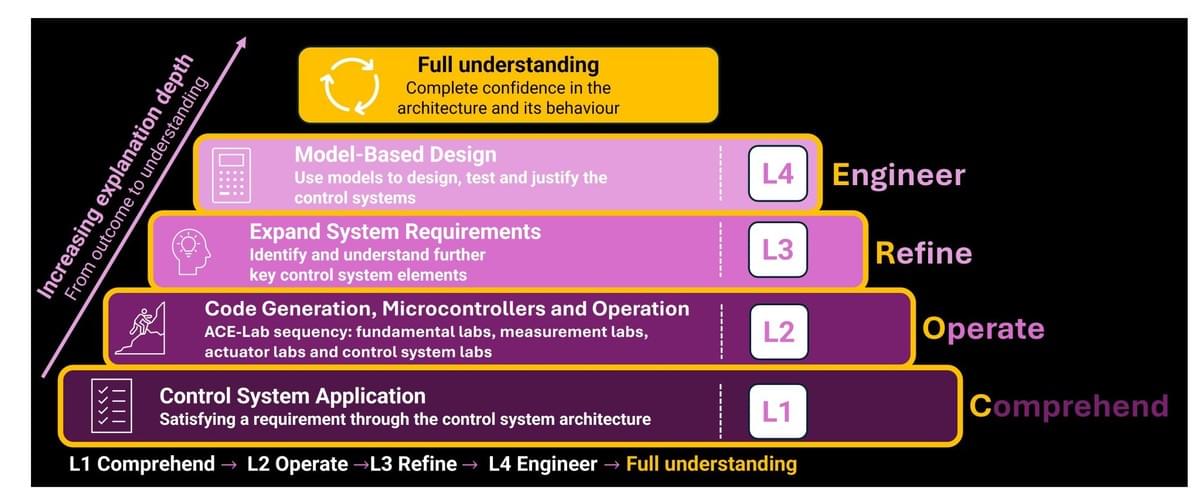
ACE-CORE provides a structured framework for supporting this progression through four stages:
Comprehend → Operate → Refine → Engineer
At the Comprehend stage, learners establish an understanding of the control problem, system requirements and fundamental concepts. The Operate stage introduces practical interaction with the control system and its hardware.
Learners then move to Refine, where controllers, models and system behaviour are progressively improved. Finally, the Engineer stage introduces more advanced engineering activities, including modelling, system identification, simulation, controller design and model-based design.
The approach combines application-led learning, portable low-cost ACE-Lab hardware and the structured ACE-CORE methodology.
Rather than treating practical work as an activity that follows the theory, ACE-CORE places practical engagement within the learning process from the outset and then uses it as a route towards increasingly sophisticated engineering analysis.
The aim is to help learners progress from practical control engineering training towards the deeper understanding required to make appropriate, evidence-based engineering decisions.
The accompanying paper, Bridging Training and Education in Control Engineering through a Structured Comprehend-Operate-Refine-Engineer (CORE) Framework, provides further detail on the approach.